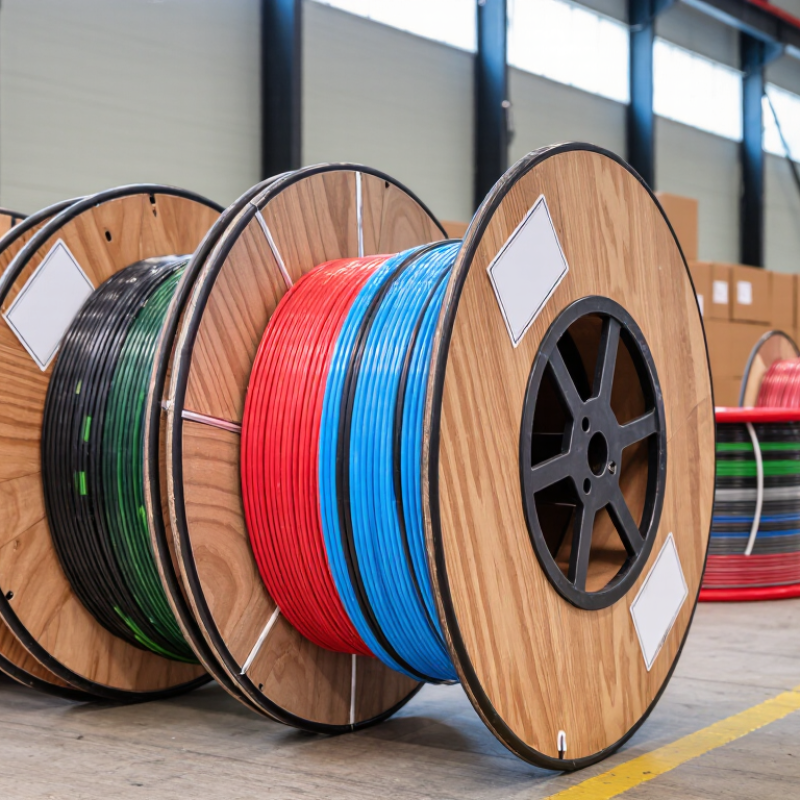
Global sourcing 4 awg thhn wire is not simply a price comparison. Buyers must match conductor size, insulation markings, spool lengths, and documentation to the intended installation. A clean label on a wooden reel matters: it should identify the conductor, insulation type, manufacturer, and applicable ratings. Small discrepancies can delay receiving checks or create costly rework.
A useful draft quotation for a qualified sourcing expert to review—not a verified statement from a real person—is: “A dependable wire order begins with the markings you can verify, not the price you can advertise.” The illustrative speaker, Evan Cole, is fictional. Replace this line with a sourced quotation before publication. That distinction matters.
4 AWG THHN generally describes a conductor size and insulation type, but the marking alone does not settle every application question. Check whether the product also carries a THWN-2 marking when wet-location use is required. Confirm temperature ratings, conductor material, stranding, and relevant certifications against the project specification. Ampacity can depend on installation conditions, terminals, and applicable electrical requirements. A datasheet is useful. A certificate should be traceable to the actual product batch.
Global supply chains add practical friction. One shipment may arrive on several reels, with different lot codes or labeling quality. Ask for clear product photographs, packing details, and document review before dispatch. This is not foolproof. Supplier claims still need checking. But careful verification makes 4 awg thhn easier to source consistently across markets, without treating one familiar label as a universal guarantee.
4 AWG THHN is a single-conductor building wire size, not a complete cable specification. The American Wire Gauge system defines conductor size; 4 AWG copper has a nominal cross-sectional area of about 21.2 mm². Stranding affects flexibility, but not the nominal gauge. THHN identifies thermoplastic insulation with a heat-resistant nylon jacket, as described in UL 83. Its 90°C rating applies in dry locations; wet-location use requires suitable markings, such as THWN-2. Markings matter.
For sourcing, specify conductor material, stranding, insulation type, voltage rating, temperature rating, and applicable standard. NFPA 70’s ampacity table lists 4 AWG copper at 85 amperes in the 75°C column and 95 amperes in the 90°C column, under stated installation conditions. These figures are not universal operating limits: terminal ratings, ambient temperature, and bundled conductors can reduce allowable ampacity. That distinction matters.
A product description should also distinguish bare conductor size from finished outside diameter, which affects conduit fill and handling. Request legible reel markings and a test certificate that matches the ordered construction. THHN is a U.S. designation, so international buyers should compare the actual insulation, voltage, and test requirements rather than assume another standard is equivalent. That comparison can be tedious. It prevents costly specification mismatches.
AWG defines the conductor’s nominal size: 4 AWG copper has a cross-sectional area of approximately 21.15 mm² and a nominal bare-conductor diameter of 5.19 mm. THHN identifies the wire’s insulation type and applicable ratings; it does not change the AWG conductor size. Confirm the required material, temperature rating, voltage rating, and local code or certification requirements when sourcing.
A 4 AWG conductor offers a useful balance between current capacity and voltage drop, but its size alone does not determine performance. NFPA 70 (2023), Table 310.16, lists 4 AWG copper at 85 amperes in the 75°C column and 95 amperes in the 90°C column. Those figures assume specified installation conditions. Terminal ratings, ambient heat, and bundled cables can reduce allowable ampacity. Real runs are less tidy than tables.
Insulation changes the limits. UL 83 rates THHN insulation for 90°C dry locations; confirm the cable’s full marking before specifying it for damp or wet environments. In practice, a dual THHN/THWN-2 marking can affect where the wire is suitable, while equipment terminals may still impose a lower temperature limit. That detail matters. A 90°C insulation rating does not automatically permit a 90°C operating design. For global sourcing, compare conductor material, insulation marking, test documentation, and applicable local standards—not just the AWG label. One caveat: equivalent-looking wires may differ in strand construction and resistance, so request verified specifications for the exact product.
A 4 AWG THHN conductor can suit demanding building circuits, but its familiar name does not guarantee acceptance worldwide. In North American specifications, verify the applicable UL 83 listing and the wire’s printed markings. Check conductor material, insulation type, voltage rating, and temperature limits against the project documents. Small details matter. A missing or unclear marking can delay inspection.
Global buyers should confirm requirements in the destination market before ordering. Canadian projects may require applicable CSA certification, while other regions may expect conformity with local or IEC-based standards. These systems are not interchangeable by default. THHN construction may not match a local cable designation, even when conductor size appears similar. Ask the supplier for current certificates, test reports, and traceability linking the documents to the delivered production lot.
A practical review includes checking the drum label, datasheet, and certificate together. Confirm that all three identify the same 4 AWG size and insulation construction. Also clarify whether the product is approved for the intended dry or wet location. A certificate alone may not settle every question. I would still request written confirmation from the importer or project engineer, especially when specifications use unfamiliar terms. That extra check can feel slow, but it is cheaper than discovering a mismatch after the wire reaches the site.
A 4 AWG THHN conductor can serve practical roles in commercial buildings, workshops, and equipment installations. Its relatively large copper or aluminum core carries more current than smaller conductors, subject to material, insulation rating, terminal temperature, and installation conditions. The thermoplastic insulation and nylon jacket help resist heat and abrasion during pulls through conduit. That matters in long runs with bends, where a damaged jacket can create problems later.
Installers may use it for feeders, machinery connections, or distribution circuits when the design calls for that size. Not everywhere. THHN is generally intended for dry locations; conductors marked THHN/THWN-2 may also be rated for wet locations, but the actual product markings should be checked. Conduit fill, voltage drop, ambient heat, and compatible terminals also affect selection. A wire that fits one project may be unsuitable for another. For global sourcing, clear documentation of conductor material, insulation markings, and test specifications helps buyers compare products across suppliers. I would still verify these details before ordering, since a familiar wire designation does not guarantee identical ratings or acceptance in every market.
When sourcing 4 AWG THHN wire globally, buyers should verify the designation, not only the advertised size. “4 AWG” describes conductor area, while THHN describes insulation performance. NFPA 70 (2023), Table 310.16, lists 85 amperes for 4 AWG copper at 75°C. The 90°C rating is useful for adjustment calculations, but not always for final ampacity. Local installation rules control.
Check the conductor metal, stranding, insulation thickness, voltage rating, and jacket markings. UL 83 covers thermoplastic-insulated wires and cables, while ASTM B8 addresses concentric-lay-stranded copper conductors. Request current test reports, production-lot traceability, and clear photographs of the printing. A certificate alone is not proof. Ask whether the cable is marked THHN only or THHN/THWN-2, because wet-location requirements differ. That distinction matters.
Buyers should also compare measured resistance and outside diameter against the applicable specification. A lower price may reflect thinner insulation, inconsistent copper, or incomplete documentation. Request samples from more than one production lot. Do not guess. In practice, packaging errors and mixed conductor materials can survive a basic visual inspection. Voltage-drop calculations deserve equal attention, especially on long industrial runs. The 4 AWG label feels precise, yet global interpretations can vary. Recheck the governing electrical code, importer requirements, and certification scope before approving shipment.
| Verification Dimension | Reference Data for 4 AWG Copper THHN | Why It Matters for Global Buyers | What the Buyer Should Verify |
|---|---|---|---|
| Conductor size | 4 AWG; nominal conductor area is approximately 21.15 mm². | AWG and metric cross-section systems are not exact equivalents, so the order specification must be unambiguous. | Confirm the marking, conductor area, stranding construction, and applicable dimensional standard on the datasheet and inspection report. |
| Conductor material | Copper conductor; stranded construction is commonly used for installation flexibility. | Copper provides high conductivity and is widely accepted in commercial, industrial, and distribution wiring applications. | Verify copper purity or conductivity, conductor class, strand count, strand diameter, and whether the conductor is bare, tinned, or plated. |
| Voltage rating | THHN conductors are commonly rated at 600 V. | The rating must match the system voltage and the electrical code governing the installation location. | Check the jacket or insulation marking, certificate scope, test voltage, and the destination country’s electrical requirements. |
| Temperature rating | THHN: 90°C maximum in dry locations. THHN alone does not indicate a 90°C wet-location rating. | Using a dry-location product in a wet environment can create a compliance and safety risk. | If wet-location installation is required, verify whether the product is additionally marked THWN or THWN-2 and confirm the applicable temperature rating. |
| Ampacity reference | For 4 AWG copper under common NEC Table 310.16 conditions, the reference ampacities are 70 A at 60°C, 85 A at 75°C, and 95 A at 90°C. | Ampacity is affected by ambient temperature, number of current-carrying conductors, termination limits, installation method, and local code rules. | Do not use 95 A automatically. Confirm the applicable code, terminal temperature rating, correction factors, and adjustment factors for the actual installation. |
| Electrical resistance | Theoretical resistance of a 21.15 mm² copper conductor is approximately 0.815 Ω/km at 20°C, before considering strand lay and manufacturing tolerances. | Resistance affects voltage drop, heat generation, operating efficiency, and long-distance project cost. | Request a measured DC resistance value at a stated reference temperature and compare it with the specified standard or project limit. |
| Insulation construction | THHN commonly uses thermoplastic PVC insulation with a nylon outer coating. | Insulation construction influences abrasion resistance, chemical resistance, stripping performance, and installation durability. | Verify insulation material, average and minimum thickness, nylon coating integrity, color, surface quality, and dimensional tolerances. |
| Applicable standards | Common North American references include UL 83 for thermoplastic-insulated wires and cables and ASTM B8 for concentric-lay-stranded copper conductors. | A product may comply with one market’s standard but not automatically satisfy another market’s approval requirements. | Confirm the exact standard edition, certification scope, marking authorization, test reports, and destination-market acceptance before purchasing. |
| Outer diameter and installation | Finished outside diameter varies with strand construction, insulation thickness, and manufacturing tolerances. | Actual diameter affects conduit fill, pulling tension, bending radius, gland selection, and installation labor. | Request the guaranteed maximum outside diameter, minimum bending radius, pulling limitations, and recommended termination hardware. |
| Length and packaging | Reel, drum, and coil lengths are project-specific; there is no single universal commercial length for 4 AWG THHN wire. | Incorrect packaging can increase freight cost, handling time, damage risk, and material waste. | Specify requested length tolerance, package dimensions, gross and net weight, drum protection, moisture protection, and length measurement method. |
| Traceability and markings | Typical markings identify conductor size, insulation type, voltage rating, temperature rating, and applicable certification marks. | Permanent identification supports installation accuracy, customs documentation, field inspection, and warranty traceability. | Approve the marking layout, print durability, production lot code, meter or foot sequence, country-of-origin information, and packing-list details. |
| Quality-control documents | Relevant records may include conductor resistance, dimensional measurements, high-voltage testing, spark testing, visual inspection, and final length verification. | Objective records reduce the risk of receiving nonconforming material in international shipments. | Define the inspection plan, sampling level, acceptance criteria, required test instruments, calibration records, and independent pre-shipment inspection requirements. |
| Environmental and compliance documents | RoHS, REACH, conflict-minerals, and recycling declarations are regulatory or customer-documentation matters rather than automatic properties of all THHN wire. | Import and project requirements differ by jurisdiction, industry, and end use. | Request current declarations, restricted-substance information, safety data where applicable, and confirmation that documents cover the exact product supplied. |
Note: Ampacity and compliance values must be confirmed against the electrical code, certification requirements, and installation conditions applicable in the destination market. Product construction and certification markings should be verified from the current technical file and physical samples.